
DESHKVEER
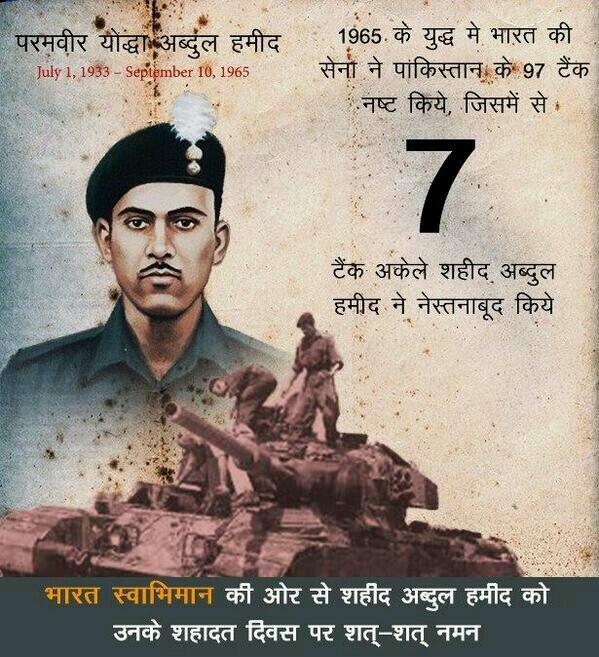
"ONE MEN ARMY"
“Our Flag Does Not Fly Because The Wind Moves It,
It Flies With The Last Breath Of Each Soldier Who Died Protecting It.”
“Our Flag Does Not Fly Because The Wind Moves It,
It Flies With The Last Breath Of Each Soldier Who Died Protecting It.”
The Indo-Pakistani War of 1965 was a culmination of skirmishes that took place between April 1965 and September 1965 between Pakistan and India. The conflict began following Pakistan's Operation Gibraltar, which was designed to infiltrate forces into Jammu and Kashmir to precipitate an insurgency against Indian rule. India retaliated by launching a full-scale military attack on West Pakistan. The seventeen-day war caused thousands of casualties on both sides and witnessed the largest engagement of armored vehicles and the largest tank battle since World War II.[19][20] Hostilities between the two countries ended after a United Nations mandated ceasefire was declared following diplomatic intervention by the Soviet Union and the United States, and the subsequent issuance of the Tashkent Declaration. Much of the war was fought by the countries' land forces in Kashmir and along the border between India and Pakistan. This war saw the largest amassing of troops in Kashmir since the Partition of British India in 1947, a number that was overshadowed only during the 2001–2002 military standoff between India and Pakistan. Most of the battles were fought by opposing infantry and armoured units, with substantial backing from air forces, and naval operations. The war exposed Pakistan's inadequate standards of military training, its misguided selection of officers, poor command and control arrangements, poor intelligence gathering and bad intelligence procedures. In spite of these shortcomings, the Pakistan Army managed to fight the larger Indian Army.[22] Many details of this war, like those of other Indo-Pakistani Wars, remain unclear. Despite the cease-fire rendering the conflict militarily inconclusive, both India and Pakistan claimed victory. Most neutral assessments, however, agree that India had the upper hand over Pakistan when the ceasefire was declared. Though officially deemed to be militarily inconclusive, the conflict is widely seen as a strategic and political defeat for Pakistan, as it had neither succeeded in fomenting insurrection in Kashmir nor had it been able to gain meaningful support at an international level. Internationally, the war was viewed in the context of the greater Cold War, and resulted in a significant geopolitical shift in the subcontinent. Before the war, the United States and the United Kingdom had been major material allies of both India and Pakistan, as their primary suppliers of military hardware and foreign developmental aid. During and after the conflict, both India and Pakistan felt betrayed by the perceived lack of support by the western powers for their respective positions; those feelings of betrayal were increased with the imposition of an American and British embargo on military aid to the opposing sides.As a consequence, India and Pakistan openly developed closer relationships with the Soviet Union and China, respectively.The perceived negative stance of the western powers during the conflict, and during the 1971 war, has continued to affect relations between the West and the subcontinent. In spite of improved relations with the U.S. and Britain since the end of the Cold War, the conflict generated a deep distrust of both countries within the subcontinent which to an extent lingers to this day. India never suspected that China would ever launch an attack, but it did. India was attacked on October 20, 1962 in what famously came to be known as Sino-India war of 1962. The belief of not ever being attacked by China did not let the Indian army prepare and the result was the standoff between 10,000-20,000 Indian troops and 80,000 Chinese troops. The war continued for about a month and ended on November 21, 54 years ago, after China declared a ceasefire.
On 5 August 1965 between 26,000 and 33,000 Pakistani soldiers crossed the Line of Control dressed as Kashmiri locals headed for various areas within Kashmir. Indian forces, tipped off by the local populace, crossed the cease fire line on 15 August. Initially, the Indian Army met with considerable success, capturing three important mountain positions after a prolonged artillery barrage. By the end of August, however, both sides had relative progress; Pakistan had made progress in areas such as Tithwal, Uri and Poonch and India had captured the Haji Pir pass, 8 km into Pakistan-Administered Kashmir. On 1 September 1965, Pakistan launched a counterattack, called Operation Grand Slam, with the objective to capture the vital town of Akhnoor in Jammu, which would sever communications and cut off supply routes to Indian troops. Ayub Khan calculated that "Hindu morale would not stand more than a couple of hard blows at the right time and place"although by this time Operation Gibraltar had failed and India had captured the Haji Pir Pass.At 3:30 hours, on 1 September 1965, the entire Chhamb area came under massive artillery bombardment. Pakistan had launched operation Grand Slam and India's Army Headquarter was taken by surprise.Attacking with an overwhelming ratio of troops and technically superior tanks, Pakistan made gains against Indian forces, who were caught unprepared and suffered heavy losses. India responded by calling in its air force to blunt the Pakistani attack. The next day, Pakistan retaliated, its air force attacked Indian forces and air bases in both Kashmir and Punjab. India's decision to open up the theatre of attack into Pakistani Punjab forced the Pakistani army to relocate troops engaged in the operation to defend Punjab. Operation Grand Slam therefore failed, as the Pakistan Army was unable to capture Akhnoor; it became one of the turning points in the war when India decided to relieve pressure on its troops in Kashmir by attacking Pakistan further south. In the valley, another area of strategic importance was Kargil. Kargil town was in Indian hands but Pakistan occupied high ground overlooking Kargil and Srinagar-Leh road. However, after the launch of a massive anti-infiltration operation by the Indian army, the Pakistani infiltrators were forced out of that area in the month of August.
.jpg)
.jpg)
.jpg)
.jpg)
.jpg)
.jpg)
.jpg)
.jpeg)
Contact Me:
Email:Deshbhagat007@gmail.com
Call:+(91) 8147174067
Follow Me: